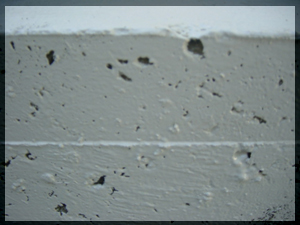
Over time concrete can crack. Ground movement, concrete shrinkage, freeze/thaw conditions can all play a part in possible cracks forming in your pond. The trouble is that when they happen, you have to go out there and fix the problem.
So how do you go about fixing a crack in a pond? Well that all depends upon the type of crack as well as the size of the crack. Cracks can be anything from small hairline cracks up to large fissures that go right through the entire structure.
The simplest of cracks is just a hairline crack. A crack like this can be easily repaired using the right materials. However, using the wrong materials can easily lead to that hairline crack turning into something far worse.
Far worse simply means more resources to affect the repair. Cash and time are things everyone wants to avoid dumping into repairs so taking your time to think the situation through is very important.
Let’s say you have a crack. The first thing you should try and do is determine how bad the structure has been affected. If it’s a hairline crack, it probably does not go through the entire structure, which is good for you.
If the crack goes through the structure you might have your work cut out for you. In severe cases there isn’t a lot of repair that can be done. But those instances are pretty rare if the structure was made using all of the proper elements needed for good, sound construction.
There are several types of materials that can be used for repairing concrete, including, more concrete, concrete strengthening additives, bonding agents, rebar, steel mesh, epoxy (like Pond Shield epoxy) and fiberglass.
Most people tend to lean towards applying some sort of rubberized caulk into the crack. The problem there is that rubberized coatings or caulks do not bond very well to concrete and can peel.
You also end up with a crack repair that continues to move and can eventually fail again. You really need to shore up the concrete so that it acts just like it was when the crack did not exist.
For hair line cracks, an epoxy like Pond Shield can be used to coat over the crack. Coating over a crack will give you the most minimal resistance to the crack reappearing. I suggest that you use a grinder with a cutting wheel to groove the crack and THEN fill it in with Pond Shield.
What you end up with at that repair is essentially a concrete stitch. The epoxy holds the crack from both facing sides as well as across the top of the crack. Pond Shield tensile bond strength (that exceeds the internal strength of concrete) combined with its elongation break strength of 9,500 psi will pull and hold the concrete as though it were once piece.
For larger cracks, like those that are a half inch or so wide, you’ll have to consider more drastic measures. You may find yourself cleaning up the crack quite a bit by actually removing portions of concrete so that you can place new concrete into the affected area.
If you cut through rebar or steel mesh, you will have to put new rebar or steel mesh back in. Rebar and mesh help strengthen concrete as a whole. If you have to replace pieces of rebar, you can drill into through both sides of the crack at an angle so that you might glue new rebar in place.
After the stitch is in place, you can use concrete to fill in the crack. You concrete can have fibrous additives in it that will act as a strengthener. Be sure to use a good bonding agent on concrete before filling it in. This will aid in the adhesion between the old concrete and the new concrete.
Once the concrete has set up and cured properly, cut the rebar off that is sticking out of the concrete. Make sure to try and cut it lower than the surface of the concrete. Then apply your epoxy to seal the rebar and prevent any corrosion.
Because concrete is porous, I recommend that you coat the entire surface that will be submerged in water. This will keep the water from soaking through the concrete and reaching the rebar beneath where it can corrode there too.
For added strength, you can also apply a strip of fiberglass over the crack as well. Just apply the strip while the Pond Shield is still wet and saturate it out completely. Once cured, the complete repair ought to be much stronger than the original concrete was.
*******************************
If you’re looking for a non toxic solution to water proofing your pond, fountain or water feature, please visit the Pond Armor site. If you have any questions regarding the products Pond Armor manufactures, please contact us at 800-716-1545 M-F 8:30am to 4:30pm PST
Nexus Filtration – This type of filtration utilizes either a pump fed or gravity fed water supply from the pond to both mechanically and biologically filter the water. Essentially the water moves through the first chamber where solids are mechanically removed from the water.
Vortex Filters – Vortex filters look just what they sound like. They are large, almost conical containers that will rotate the incoming water into a vortex that allows solid matter to settle. The water is pushed into a second chamber where more settling is allowed to occur.
Bead Filters – Bead filters provide a mechanical and biological filter system in one unit. Water is pumped into the bead filter body where it fills from the bottom up. Small beads located inside the body of the filter float on top of the water.
Pressurized Filters – These filters are generally smaller and more compact in size. This makes them easy to hide and you can actually bury them almost completely in doing so. Most people would look at these filters and wonder how something that small can actually filter a pond like any of the larger filters described above.
With so much research being done at this time of year, I thought an article about the application of a coating might be an interesting topic. If you’re a professional installer that has used epoxies before, then you probably already know a great deal about the application process.