Archive for the ‘ Water Quality ’ Category

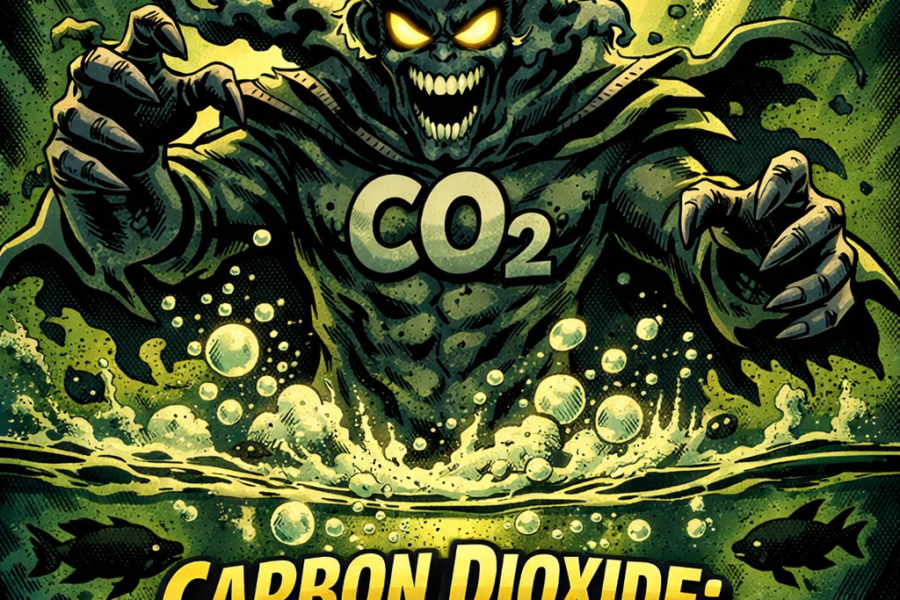
Carbon DioxideIf you haven’t taken the steps necessary to add oxygen to the water in your pond, the carbon dioxide levels may be higher than you think.  If they are, then the chances are that the concentrated levels of carbon dioxide in your fish’s blood streams may also be high.

You see carbon dioxide is more soluble in water than oxygen.  In fact oxygen levels in water become saturated at 9 ppm at 68 degrees F where carbon dioxide becomes saturated in water at .5 ppm.  In comparison to blood, the saturation levels are pretty close to being the same.

Fish will start to have problems breathing when saturation levels of carbon dioxide reach 5 ppm.  I bet you didn’t know it, but for every pound of oxygen a fishes breathes in, it exhales about 1.38 pounds of carbon dioxide.  That ratio alone puts the water oxygen levels at a deficit. 

So what can you do about it?  Well remember we talked about proper pond aeration?  That’s right.  Pumping air into your pond will increase the oxygen to carbon dioxide ratio in your pond water and make things a heck of a lot easier for your fish.

There is also a by product of proper aeration.  As the air you pump into the water floats to the surface in the form of bubbles and pop, there is a gas exchange going on.  This is where carbon dioxide is released in the process which is good fro the pond.

So basically, it really is as simple as that.  I bet you were thinking this was going to be all complicated or something huh?  Well there is one more small detail that you might be interested in.

For those of you that have an indoor pond or store your fish in an indoor pond, you need to think about where all that diffused carbon dioxide goes after it leaves your pond.  Think of all of your family members plus yourself exhaling carbon dioxide.

If you combine that along with what is expelled from the pond, you too could find yourself in danger.  You might consider some sort of air ventilation to expel the carbon dioxide outside where it won’t be harmful to you indoors.  More elaborate systems could include a degassing column.

Degassing columns will strip the carbon dioxide from the expelled gas and return fresh outdoor air back into the closed environment.

*******************************

If you’re looking for a non toxic solution to water proofing your pond, fountain or water feature, please visit the Pond Armor site. If you have any questions regarding the products Pond Armor manufactures, please contact us at 800-716-1545 M-F 8:30am to 4:30pm PST

Filamentous AlgaeOh yeah!  This is my favorite part of pond maintenance.  Not!  That darned pond algae, I just hate it.  It’s always a mess to deal with.  Fortunately there are some ways to control it so that during your pond maintenance phase, the task of cleaning it up will be much easier.

By the way, did you know that there are thousands of species of algae?  Though you may never notice, over a period of time you may never have the same dominant species of algae in your pond more than twice.

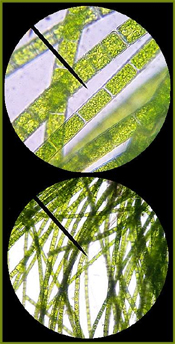
Do you know that long, thin algae that is referred to as string algae?  That type, along with black algae is a filamentous type of algae.  You’ll find them attached to something in the bottom of the pond.  They usually float to towards the surface where the process of photosynthesis can occur. 

Sometimes you might notice floating particles in the pond water.  While some of those particles can simply be dirt or pollen, some of them can also be planktonic algae.  This is the type of algae that actually changes the color of your water.  You know what I mean.  Has your pond water ever turned pea soup green before?  That’s caused by planktonic algae.

Some algae will be attached the walls of the pond, small rocks and even your waterfall.  This periphyton type of algae will resemble a slimy, green layer on those surfaces.  Of course all of these algae have one thing in common.  They all thrive very easily in a pond environment.

Your task is to keep their growth in check so that they do not overwhelm the filtration system of your pond.  Here’s six ways you can make the task of controlling algae in your pond much easier.

1. Physical removal – You can easily remove filamentous algae (string algae) with a small algae rake or fork.  Just like twirling up spaghetti on a fork, your twirl up the algae.  Pull it out and throw it away.

2. UV Lighting – By sterilizing the returning water after it has been through the main filtration process, you can effectively disrupt the reproductive process of planktonic types of algae.  This will help keep the water crystal clear.

3. Lighting – If you have the ability to control the amount of sun light your pond gets, you can effectively retard the growth process of algae too.  Using trees, or some sort of shading mechanism will not only be a deterrent in algae growth, but your fish will enjoy it too.

4. Nutrient Rich Water – This is about the hardest way to control algae growth.  The problems is that your pond water is almost always nutrient rich and algae loves nutrient rich water.  They thrive on it.  Well in reality, they thrive on the phosphorus portion of those nutrients.  That’s the part you can attempt to control.  If you use phosphorus removing agents in the water, you will deny the algae one of its main supplies of food.

5. Barley Straw – This is a good organic way to prevent algae in your pond too.  Floating a bag of barely straw will help increase the oxygen level in the pond and we all know algae is a plant and plants do not like oxygen.

6. Algaecides – In my opinion, these are the last resort in algae control.  I only feel this way because you are in essences adding a chemical agent to the pond that will kill the algae, and if you’re not careful, you can kill other plant life in the pond as well.  Of course the downside of a chemical treatment is every time you change water, the algae can bloom again because the chemical has been dissipated.

*******************************

If you’re looking for a non toxic solution to water proofing your pond, fountain or water feature, please visit the Pond Armor site. If you have any questions regarding the products Pond Armor manufactures, please contact us at 800-716-1545 M-F 8:30am to 4:30pm PST

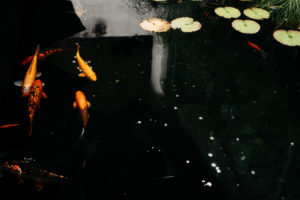
Did you know that when oxygen levels in the pond drop, that the biggest Koi are effected first?  It’s true.  Their massive bodies in comparison to the smaller fish in the pond consume much more oxygen.  The lack of therefore, causes them problems first.

Some of the key components that assist in the decrease of the Koi pond’s oxygen level are:

  1. Higher temperatures – When water temperature rises, it simply cannot hold the gasses that are usually trapped in it.  This is not only true for oxygen but for all gasses like nitrogen and carbon dioxide.
  2. Contaminants – Any sort of contaminant including an over abundance of fish waste will also cause a decrease in oxygen levels.  This is why it is so important to monitor water chemistry on a regular basis.
  3. Poor water circulation – If you are not moving enough water in and out of the pond to be filtered, the lack of circulation will cause contaminants to build, which in turn decrease the oxygen level.
  4. Salt – Yes, salt is used in certain quantities to help aid in the fight against parasites and such, but the salt level will also assist in decreasing oxygen levels.

Aerating the water is as simple and providing a way for the atmosphere and the water to mix.  Water flowing from a waterfall into a pond or the use of air stones or other devices will make this mixture happen. 

You might think that the mixing occurs when the bubbles are under the surface of the water, but this is not true.  The actual mixing process happens when the bubble burst on the surface of the water.  So having not enough bubbles or bubbles that are too large only make the transfer suffer.

This is why it is preferable to have the air to water exchange happen with an aeration system from a device like and air pump rather than just rely on the exchange made by a waterfall.

More oxygen in the water will also aid in the growth of good pond bacteria.  This is especially true at the beginning stages of creating a pond.  At that point you want to encourage a lot of bacteria (good) growth for your biological filter media.

Have you ever noticed that some pond keepers have their aeration system set just on top of the drains in the very bottom of the pond?  Because the water is being drawn from the bottom, this aeration system will circulate the pond’s total water column better.

You should never think that just because fish can breathe in water that they actually have enough oxygen to breathe.  This is a mistake.  Fish need oxygen.  Good bacteria need oxygen.  It is your job to make sure that they always have it.

*******************************

If you’re looking for a non toxic solution to water proofing your pond, fountain or water feature, please visit the Pond Armor site. If you have any questions regarding the products Pond Armor manufactures, please contact us at 800-716-1545 M-F 8:30am to 4:30pm PST